
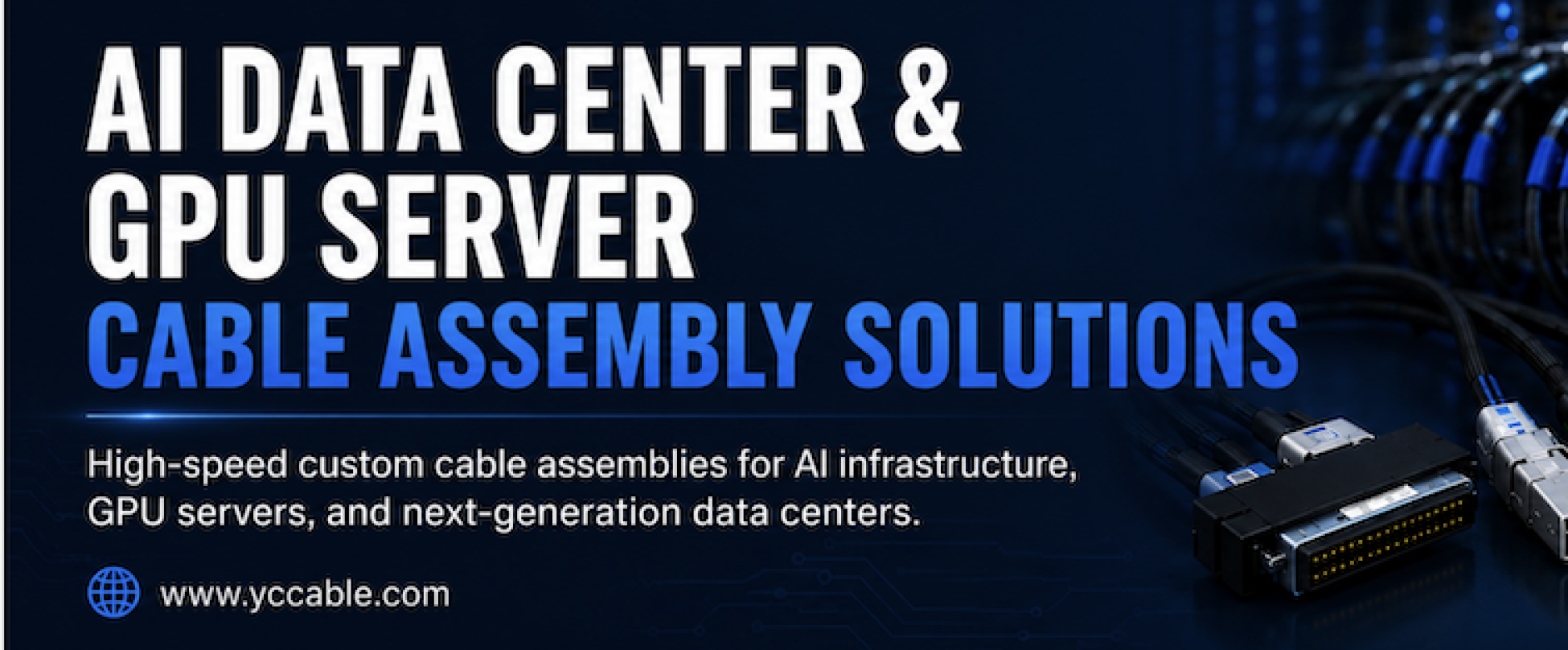
AI Data Center & GPU Server Cable Assembly Solutions
Y.C. Cable manufactures custom cable assemblies and wire harnesses for AI infrastructure, GPU server systems, data center racks, networking equipment, cooling systems, power equipment, and related electronic hardware.
Assemblies are manufactured according to customer-approved drawings, BOMs, connector requirements, electrical specifications, mechanical dimensions, and testing requirements.
Cable Assemblies for AI Infrastructure
AI and high-density computing equipment can require numerous power, signal, data, control, and internal equipment connections.
Projects may include:
• Server internal cable assemblies
• Rack-level cable assemblies
• Power cable assemblies
• Signal and control cables
• Data interconnects
• Sensor harnesses
• Cooling-system wiring
• Fan and control connections
• Equipment power distribution connections
• Internal wire harness assemblies
• Connector-based OEM cables
GPU Server & Rack Integration Requirements
High-density equipment can create challenging routing and service requirements.
Important considerations may include:
• Available routing space
• Cable diameter
• Connector orientation
• Bend radius
• Cable retention
• Airflow clearance
• Serviceability
• Labeling
• High connector density
• Power and signal separation
• Installation sequence
• Rack and enclosure layout
Providing mechanical layout information during project review can help identify manufacturing or installation concerns before production.
Power, Signal & Data Connections
Power Connections
Power assemblies should be defined around customer requirements including voltage, current, conductor size, connector system, insulation, routing, and temperature requirements.
Signal & Control Connections
Control and sensor connections may require defined pinouts, shielding, grounding, connector retention, labeling, and routing.
High-Speed Data Connections
When a project includes high-speed data requirements, the relevant cable construction, connector system, shielding, impedance, length, and testing requirements should be defined by the customer-approved specification.
This allows the assembly and inspection process to be built around the actual interface requirements instead of making a general performance assumption.
High-Density Cable Management
Dense server and rack environments can benefit from clearly defined cable lengths, routing, connector orientation, identification, and service access.
Project requirements may include:
• Controlled cable lengths
• Compact routing
• Right-angle or application-specific connector orientation
• Cable identification
• Harness branching
• Protective sleeving
• Strain relief
• Routing around fans and cooling equipment
• Service and replacement access
Connector & Cable Options
Depending on the project, assemblies may include:
• Power connectors
• Board-to-wire connectors
• Circular connectors
• Copper cable assemblies
• Ethernet and networking connections
• Custom connector systems
• Shielded cable constructions
• Multi-conductor cables
• Wire harness assemblies
For connector-based products, explore OEM Cable Assemblies.
For communication and networking applications, visit Telecom & Communication Cable Assemblies.
For copper-based interconnect products, visit Copper Cable Assemblies.
Prototype & NPI Support
New server, rack, cooling, power, and infrastructure programs may begin with:
• Engineering prototypes
• NPI builds
• First articles
• Mechanical fit evaluation
• Electrical evaluation
• Low-volume production
• Production transition
For early-stage builds, visit Quick-Turn Cable Assembly Prototyping.
For released designs, visit Build-to-Print Cable Assembly Services.
Manufacturing & Quality Requirements
Depending on the design, manufacturing may include:
• Cable preparation
• Cutting and stripping
• Crimping
• Soldering
• Connector assembly
• Shielding
• Wire harness assembly
• Protective sleeving
• Heat-shrink
• Overmolding
• Labeling
• Electrical testing
• Visual and dimensional inspection
Learn more about Cable Assembly Manufacturing Capabilities.
What We Need to Quote an AI or Data Center Project
Please provide:
• Drawing
• BOM
• Pinout
• Connector part numbers
• Cable specifications
• Voltage and current requirements
• Data or signal requirements
• Cable lengths and tolerances
• Mechanical routing information
• Prototype quantity
• Production quantity
• Annual forecast
• Inspection and testing requirements
• Target delivery date
Frequently Asked Questions
What cable assemblies are used in AI and GPU server equipment?
Applications may use power, data, signal, control, sensor, internal equipment, networking, and other cable assemblies depending on the server, rack, cooling, and infrastructure design.
Can Y.C. Cable manufacture server cables from our drawings and BOM?
Yes. Projects can be reviewed and manufactured according to customer drawings, BOMs, connector requirements, cable specifications, dimensions, and testing requirements.
Can you support prototype AI server cable assemblies?
Prototype, NPI, and first-article projects can be reviewed before repeat production.
Can you manufacture high-speed data cable assemblies?
Projects with high-speed requirements should provide the applicable interface, cable, connector, shielding, electrical, dimensional, and testing specifications so the manufacturing requirements can be reviewed against the approved design.
Request an AI Data Center Cable Quote
Send us your drawings, BOM, connector requirements, quantity, system application, and testing requirements.
Request an AI Data Center Cable Quote