
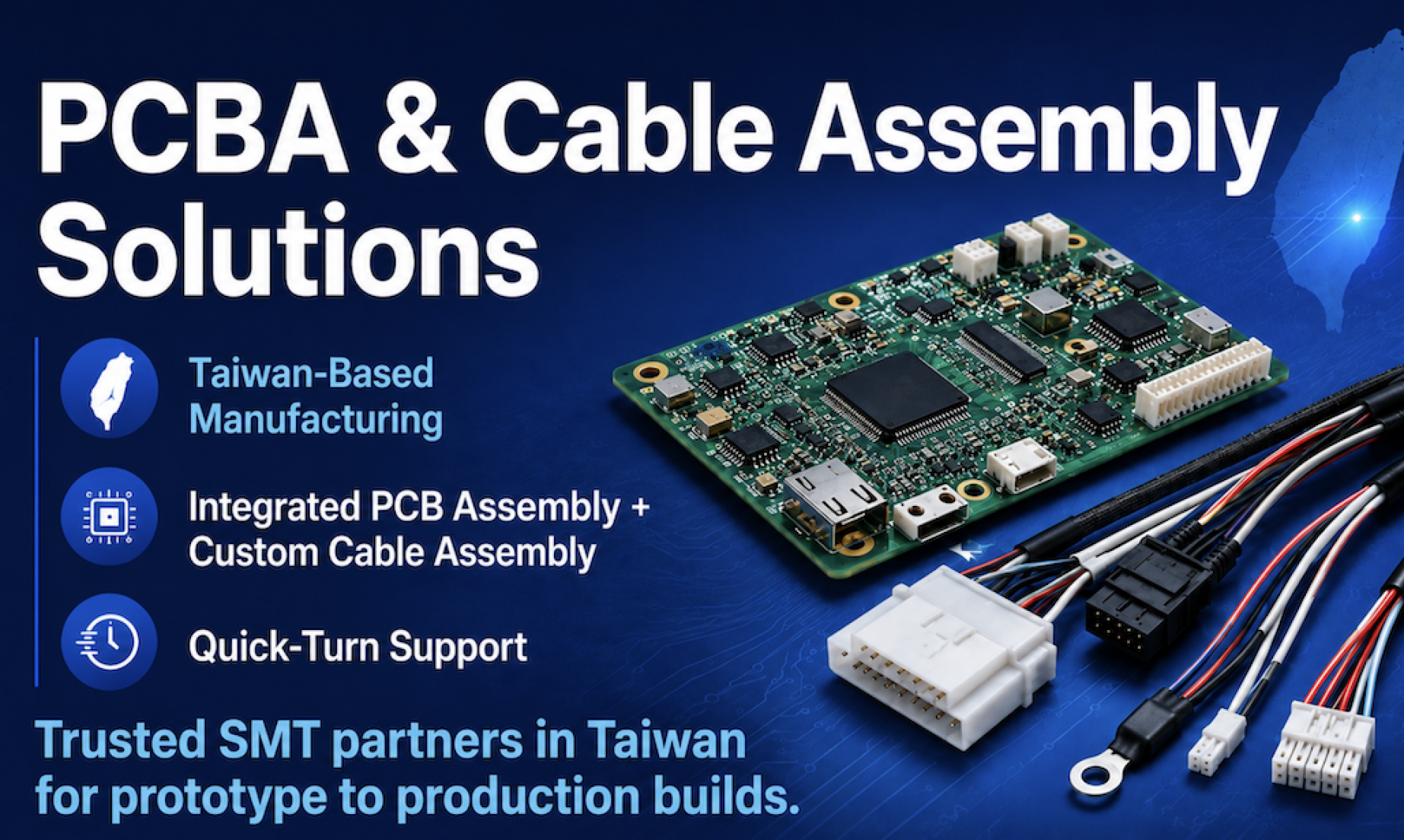
Quick-Turn Cable Assembly Prototyping
Y.C. Cable supports quick-turn cable assembly and wire harness prototyping for engineering evaluation, New Product Introduction (NPI), first-article builds, design validation, and lower-volume production.
Prototype assemblies are manufactured according to the available customer drawings, BOMs, pinouts, samples, specifications, and testing requirements.
Request a Quick Turn Quote
When to Use Quick-Turn Prototyping
Quick-turn support may be appropriate for:
• Engineering prototypes
• Proof-of-concept equipment
• New Product Introduction
• First-article builds
• Design validation
• Mechanical fit checks
• Electrical evaluation
• Pre-production builds
• Pilot production
• Lower-volume requirements
• Bridge production

Information That Helps Us Review Your Project
Providing complete technical information can reduce unnecessary questions during quotation and manufacturing review.
Please include:
• Drawing or sketch
• Bill of Materials
• Connector and terminal part numbers
• Pinout or wiring diagram
• Cable or branch dimensions
• Quantity
• Target date
• Testing requirements
• Application information
• Current revision
• Expected future production quantity
If a complete drawing is not yet available, provide the technical information currently available for initial review.
Prototype Manufacturing Workflow
1. Documentation Review
Drawings, BOMs, pinouts, quantities, schedule, and testing requirements are reviewed.
2. Technical Questions
Missing dimensions, conflicting information, unavailable materials, or unclear requirements are identified for clarification.
3. Material Availability Review
Required components and their availability are reviewed.
Potential alternatives may be discussed when appropriate and should be customer-approved before use.
4. Prototype Build
The assembly is manufactured according to the approved project information.
5. Inspection & Testing
Inspection and testing are performed according to the agreed project requirements.
6. Customer Evaluation
The customer can evaluate fit, function, installation, labeling, and other application-specific requirements.
7. Production Planning
Approved revisions can be incorporated before repeat manufacturing.
DFM & NPI Support
Prototype review may identify manufacturing concerns such as:
• Connector and terminal compatibility
• Missing dimensions
• Incomplete tolerances
• Cable routing
• Bend radius
• Strain relief
• Shield termination
• Material availability
• Label placement
• Testing access
• Assembly sequence
• Tooling or fixture requirements
For broader manufacturability and documentation support, visit Engineering Support.
First Article & Design Validation
A first-article build may help confirm:
• Materials and components
• Cable dimensions
• Branch dimensions
• Pinout
• Connector orientation
• Labeling
• Workmanship
• Electrical testing
• Installation
• Packaging
The customer-approved sample and released documentation can then support repeat production.
Factors That Affect Prototype Lead Time
Prototype timing can depend on:
• Component availability
• Connector and terminal lead time
• Assembly complexity
• Quantity
• Custom tooling
• Overmolding requirements
• Testing requirements
• Documentation completeness
• Engineering questions
• Customer approval timing
For this reason, we recommend defining the required schedule during quotation rather than relying on a standard turnaround promise.
Transition from Prototype to Production
After prototype or first-article approval, the project may transition into repeat production.
Production readiness may include:
• Final drawing release
• Final BOM release
• Revision confirmation
• Approved first article
• Production work instructions
• Testing method confirmation
• Tooling and fixture planning
• Material planning
• Forecast review
For released designs ready for repeat manufacturing, visit Build-to-Print Cable Assembly Services.
For the broader production process, visit Cable Assembly Manufacturing Services.
Prototype Cable & Wire Harness Applications
Quick-turn prototyping can support projects involving:
• Custom cable assemblies
• Wire harness assemblies
• Industrial equipment
• Automation systems
• Robotics
• Medical equipment
• Electronic equipment
• New OEM products
For application-specific customization, visit Custom Cable Assembly or Wire Harness Assemblies.
Frequently Asked Questions
What information is needed for a prototype quote?
A drawing or sketch, BOM, pinout, connector information, quantity, testing requirements, and target date are recommended.
Can you build prototypes before the final production quantity is known?
Yes. Prototype and NPI projects can be reviewed separately from the eventual production forecast.
Can prototype assemblies move into production?
Yes. After evaluation and approval, the released project documentation can support repeat production.
What affects prototype lead time?
Component availability, assembly complexity, quantity, tooling, testing requirements, documentation completeness, and approval timing can all affect lead time.
H3: Can you review component alternatives if a part is unavailable?
Potential alternatives may be identified for customer review when appropriate. Customer approval should be obtained before substitution.
Request a Prototype Quote
Send us your drawing, BOM, pinout, quantity, target date, and testing requirements.
Our team will review the available documentation and identify the information needed for quotation.