What Are Cookies
As is common practice with almost all professional websites this site uses cookies, which are tiny files that are downloaded to your computer, to improve your experience. This page describes what information they gather, how we use it and why we sometimes need to store these cookies. We will also share how you can prevent these cookies from being stored however this may downgrade or 'break' certain elements of the sites functionality.
PRODUCTS
Custom Cable Assembly Manufacturing
Y.C. Cable manufactures custom cable assemblies for OEMs, equipment manufacturers, product developers, and industrial customers with application-specific electrical, mechanical, and environmental requirements.
Unlike standard off-the-shelf cables, a custom cable assembly can be configured around the connector system, wire and cable construction, pinout, shielding, overmolding, strain relief, labeling, routing, installation environment, and testing requirements of the finished equipment.
Projects are manufactured according to customer-approved drawings, bills of materials (BOM), specifications, pinouts, samples, and revision-controlled documentation.
Built Around Your Application Requirements
Every application has different technical requirements. Important project inputs may include:
• Voltage and current requirements
• Signal or data requirements
• Connector and terminal selection
• Wire gauge and conductor configuration
• Cable length and dimensional tolerances
• Pinout and circuit configuration
• Shielding and grounding
• Cable routing
• Bend radius
• Mechanical movement or vibration
• Temperature and environmental exposure
• Strain relief and connector protection
• Identification and labeling
• Inspection and testing requirements
Providing these requirements during project review helps determine an appropriate cable construction and manufacturing process.
Custom Cable Assembly Options
Depending on the project, cable assemblies may be configured with:
• Customer-specified wire and cable
• Custom cable lengths
• Multiple wire gauges
• Customer-approved connectors and terminals
• Custom pinouts
• Multi-conductor configurations
• Multi-branch configurations
• Shielded or unshielded cable
• Foil or braided shielding
• Drain wires and grounding
• Protective sleeving or tubing
• Heat-shrink protection
• Overmolded connectors
• Mechanical strain relief
• Grommets and boots
• Labels and wire identification
• Customer-defined packaging
For a broader overview of available products, visit our Cable Assembly Products & Manufacturing Solutions page.
Connector & Termination Requirements
Connector selection can affect electrical performance, installation, serviceability, mechanical strength, and available routing space.
Custom cable assemblies can be manufactured around customer-approved connector and terminal systems, including:
• Board-to-wire connectors
• Circular connectors
• M8 and M12 connectors
• Power connectors
• Signal and data connectors
• USB and USB-C connectors
• RF and coaxial connectors
• Molex connector systems
• JST connector systems
• Customer-specified connector families
For connector-based product families, explore our OEM Cable Assemblies.
Shielding, Protection & Overmolding
Cable protection should be selected around the actual operating environment.
Depending on customer requirements, protection may include:
• EMI/RFI shielding
• Braided or foil shielding
• Drain-wire configurations
• Protective sleeving
• Flexible tubing
• Heat-shrink protection
• Abrasion protection
• Connector backshell protection
• Overmolding
• Molded strain relief
• Application-specific cable jackets
For applications requiring molded connector protection or strain relief, visit our Overmolded Cable Assemblies page.
Electrical, Mechanical & Environmental Considerations
Electrical Requirements
Project documentation may define voltage, current, signal type, grounding, shielding, insulation, impedance, or customer-specific electrical test requirements.
Mechanical Requirements
Mechanical requirements may include routing, bend radius, connector orientation, strain relief, pull requirements, vibration, movement, mounting, and available installation space.
Environmental Requirements
Material selection may depend on temperature, moisture, dust, oil, chemicals, abrasion, UV exposure, cleaning processes, or other application-specific conditions.
Prototype to Production Support
Custom cable assembly projects may begin with:
• Engineering prototypes
• New Product Introduction (NPI)
• First-article builds
• Design validation
• Low-volume production
• Repeat production
• Ongoing production programs
For prototype, NPI, and first-article requirements, visit Quick-Turn Cable Assembly Prototyping.
For released designs with approved drawings and BOMs, visit Build-to-Print Cable Assembly Services.
Manufacturing Processes
Depending on the assembly design, manufacturing may include:
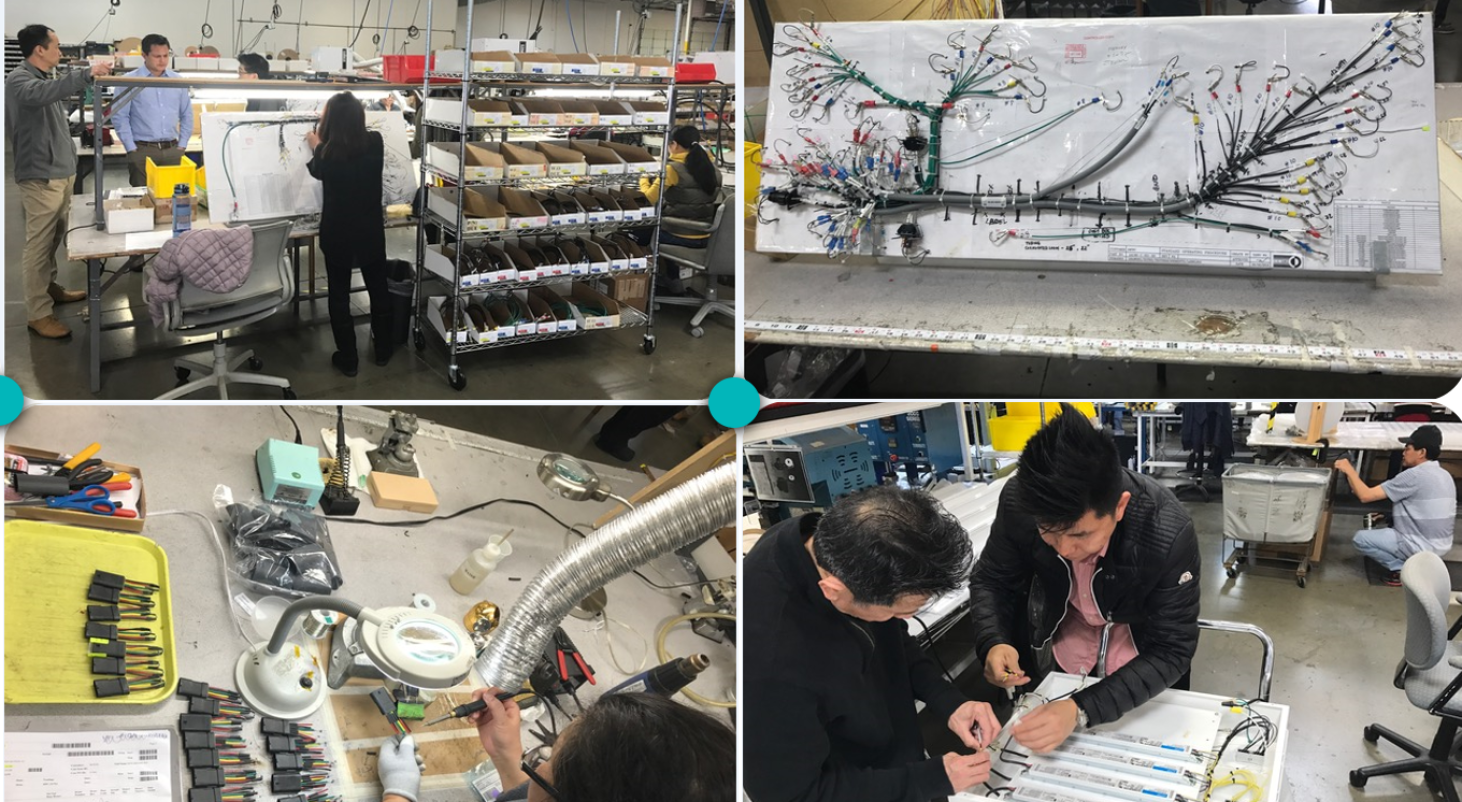
• Wire and cable cutting
• Insulation stripping and preparation
• Crimping and terminal installation
• Solder termination
• Connector assembly
• Wire harness assembly
• Shield preparation and termination
• Protective sleeving
• Heat-shrink application
• Overmolding
• Strain relief
• Labeling and identification
• Electrical testing
• Visual and dimensional inspection
Learn more about our Cable Assembly Manufacturing Capabilities.
Custom Cable Assembly Applications
Custom cable assemblies can support a wide range of equipment and markets.
Explore our application-specific solutions for Industrial Cable Assemblies, Medical Cable Assemblies, Automotive Cable Assemblies, and Custom Robotic Cable Assemblies.
For automation equipment, PLC systems, sensors, machine vision, AGVs, and smart manufacturing, visit Automation & Robotics Cable Solutions.
What We Need to Quote
Please provide as much of the following information as possible:
• Drawing, sketch, or sample
• Bill of Materials (BOM)
• Pinout or wiring diagram
• Connector and terminal part numbers
• Cable and wire specifications
• Required length and tolerances
• Prototype or production quantity
• Estimated annual volume
• Application and operating environment
• Inspection and testing requirements
• Current revision level
• Target delivery date
Frequently Asked Questions
What makes a cable assembly custom?
A custom cable assembly is manufactured around application-specific requirements such as connector type, cable construction, pinout, shielding, length, environmental protection, labeling, or testing.
Can Y.C. Cable manufacture from our existing drawings and BOM?
Yes. Customer drawings, BOMs, specifications, pinouts, and approved revision information can be used as the manufacturing basis.
Can you manufacture from an existing sample?
An existing sample may be useful when drawings are incomplete or unavailable. Additional documentation may still be required before controlled production.
For projects requiring documentation development or manufacturability review, visit Engineering Support.
Can custom cable assemblies include overmolding?
Depending on the application and project requirements, overmolding can be used for connector protection, strain relief, cable transitions, or other mechanical requirements.
Can a prototype transition into production?
Yes. After the prototype or first article is reviewed and the production documentation is approved, the project can move into repeat manufacturing.
Request a Custom Cable Assembly Quote
Send us your drawings, BOM, specifications, quantities, application information, and testing requirements.
Our team will review the available documentation and identify any additional information needed for quotation and manufacturing review.
Request a Custom Cable Assembly Quote