
What Are Cookies
As is common practice with almost all professional websites this site uses cookies, which are tiny files that are downloaded to your computer, to improve your experience. This page describes what information they gather, how we use it and why we sometimes need to store these cookies. We will also share how you can prevent these cookies from being stored however this may downgrade or 'break' certain elements of the sites functionality.
PRODUCTS
Custom USB-C Cable Assemblies
Y.C. Cable manufactures custom USB-C cable assemblies for OEMs, equipment manufacturers, product developers, and electronic systems requiring customer-defined USB Type-C connections.
Assemblies are manufactured according to customer-approved drawings, bills of materials (BOM), connector configurations, cable specifications, data requirements, current requirements, cable lengths, shielding, mechanical requirements, and testing criteria.
USB Type-C defines the connector interface, while data performance and power capability depend on the complete cable design and applicable USB requirements. For this reason, each project should clearly identify the required data, current, power, connector, and application requirements.
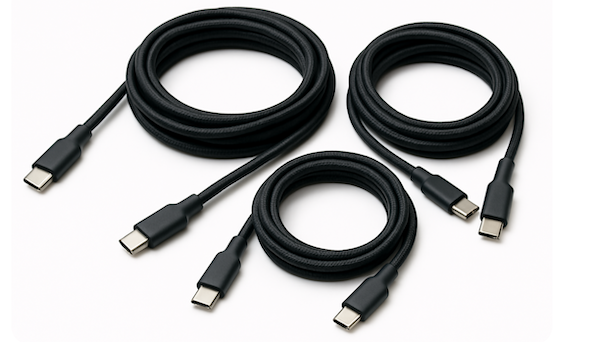
Custom USB-C Cable Configurations
Depending on the approved design, USB-C cable assemblies may include:
• USB-C to USB-C
• USB-A to USB-C
• Single-ended USB-C assemblies
• Internal equipment USB-C connections
• Custom-length USB-C cables
• Data-focused cable assemblies
• Charging and power cable assemblies
• Shielded USB-C cables
• Overmolded USB-C assemblies
• Customer-specific connector and cable configurations
For specific USB-C product configurations, explore our USB Type-C Cable Products.
Data Performance Requirements
A USB Type-C connector does not by itself determine the supported data rate.
Project documentation should identify the required interface and data capability, such as:
• USB 2.0 / 480Mbps when applicable
• USB 5Gbps when applicable
• USB 10Gbps when applicable
• Other customer-defined USB performance requirements
The cable construction, conductor configuration, shielding, connector system, cable length, and testing requirements should be selected according to the intended data performance.
For a current 10Gbps product configuration, visit our USB 10Gbps Type-C Cable page.
For USB 2.0 configurations, explore our USB 2.0 Type-C Cable 5A and USB 2.0 Type-C Cable 3A products.
Current & Power Requirements
Current and power capability should be defined separately from the USB Type-C connector itself.
Useful project information may include:
• Required current
• Required power capability
• Cable conductor requirements
• USB Power Delivery requirements when applicable
• E-marker requirements when applicable
• Connector specifications
• Cable length
• Voltage-drop requirements when specified
• Electrical testing requirements
A current rating alone should not be used to assume the complete power capability of a finished USB-C cable.
E-Marker Requirements
Some USB-C cable configurations require an electronically marked cable assembly.
When an E-marker is required, project documentation should identify the applicable cable and USB requirements.
Important information may include:
• Required current capability
• Required data performance
• Cable configuration
• USB-C connector configuration
• Applicable E-marker component
• Customer or compliance requirements
For example, our current USB 2.0 Type-C Cable 5A product configuration includes an E-marker, while the current USB 2.0 Type-C Cable 3A configuration does not.
Cable Construction & Customization
Custom USB-C assemblies may be manufactured around requirements including:
• Cable length
• Wire gauge
• Conductor construction
• Cable diameter
• Shielding
• Grounding
• Cable jacket
• Connector shell
• Connector orientation
• Overmolding
• Strain relief
• Color
• Labels and identification
• Customer packaging requirements
For molded connector and strain-relief options, visit Overmolded Cable Assemblies.
Connector & Mechanical Requirements
Important mechanical considerations may include:
• Connector orientation
• Straight or application-specific cable exit
• Cable bend radius
• Routing space
• Connector retention
• Strain relief
• Repeated connection requirements
• Cable flexing
• Installation environment
• Connector and cable dimensions
These requirements should be defined around the finished equipment rather than assumed from the USB-C connector alone.
USB-C Applications
Custom USB-C cable assemblies may support:
• Consumer electronics
• Industrial equipment
• Computing equipment
• Test equipment
• Medical electronics
• Charging systems
• Embedded devices
• Data and communication equipment
• Other OEM products
For broader consumer electronics applications, visit Consumer Electronics Cable Assemblies.
Prototype to Production
USB-C projects may include:
• Engineering prototypes
• NPI builds
• First articles
• Electrical evaluation
• Mechanical fit evaluation
• Low-volume production
• Repeat manufacturing
For development-stage projects, visit Quick-Turn Cable Assembly Prototyping.
For released designs with approved drawings and BOMs, visit Build-to-Print Cable Assembly Services.
Manufacturing & Testing
Depending on the approved USB-C design, manufacturing may include:
• Cable preparation
• Wire stripping
• Connector termination
• Soldering or other specified termination processes
• Shield preparation
• Connector assembly
• Overmolding
• Strain relief
• Labeling
• Electrical continuity testing
• Pinout verification
• Customer-defined data testing
• Customer-defined power testing
• Visual and dimensional inspection
Learn more about Cable Assembly Manufacturing Capabilities.
What We Need to Quote a USB-C Cable Assembly
Please provide:
• Drawing
• BOM
• Connector configuration
• Required USB data capability
• Current and power requirements
• E-marker requirement when applicable
• Cable specification
• Cable length and tolerance
• Shielding requirements
• Mechanical requirements
• Prototype or production quantity
• Estimated annual volume
• Testing requirements
• Current revision
• Target delivery date
Frequently Asked Questions
Does every USB-C cable support the same data speed?
No. USB Type-C describes the connector interface. Supported data performance depends on the complete cable design and applicable USB specification.
Does every USB-C cable support the same charging power?
No. Current and power capability depend on the cable design, conductors, E-marker requirements, USB Power Delivery requirements, and other applicable specifications.
Can Y.C. Cable manufacture a custom USB-C cable from our drawing and BOM?
Yes. Projects can be reviewed using customer drawings, BOMs, connector requirements, cable specifications, data and power requirements, dimensions, quantities, and testing criteria.
Can USB-C cable assemblies include overmolding?
Yes, when overmolding is compatible with the connector, cable, tooling, geometry, and project requirements.
Can you support prototype USB-C cable assemblies?
Yes. Prototype and first-article builds can support electrical, mechanical, and product evaluation before repeat manufacturing.
Request a Custom USB-C Cable Quote
Send us your drawing, BOM, connector configuration, data requirements, current and power requirements, cable specification, quantity, and testing criteria.